Private Residence
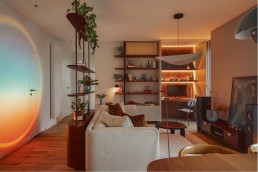
In Bydgoszcz, Poland, a riverside apartment becomes a sanctuary where the spirit of flight meets the comforts of home. Inspired by their clients’ love of gliding, designers Jakub Żurawicki and Joanna Kubiak shaped an airy, light-filled space that balances work, rest, and passion in perfect harmony.
In the heart of Bydgoszcz, Poland, an apartment perched on the Brda River became the home of two young professionals. Active enthusiasts of travelling, gliding and the great outdoors, the pair bought the designed apartment to gain more than just a place to call home but a sanctuary to pause, recharge, and find the balance between constant movement, work life, rest and rejuvenation.
Interior designers Jakub Źurawicki and Joanna Kubiak were tasked with tailoring the apartment to every facet of the owner’s life, from work and studying, to spending quality time with loved ones, in turn creating a multifunctional open plan living area. The pair developed a concept rooted in the client’s passion for the sky, with their main hobby being open-air gliding. Rather than resorting to literal motifs to express the concept, the designers introduced subtle gestures of lightness and flight in the form of soft cloud-like fabrics, airy blue palettes, and above all, a considered lighting scheme that ties all the elements together.
Źurawicki and Kubiak were hired through a recommendation from previous clients. The first objective was clear: to create an interior that would reflect their love for flying, while also functioning as a flexible home base. The first step of the project meant expanding the zone of the apartment to achieve an open living area. Ultimately leading to the elimination of a whole room by removing a wall to create the multifunctional space the owner’s desired. However, the space is still defined by a kitchen, a dining area, and a lounge, but is instead defined subtly through furniture arrangement, a shelving unit as a divider and zoned lighting rather than a large physical partition.
Lighting played a crucial role in defining the zones and creating balance between the narrative of sky travel and creating a calming sanctuary. Flos architectural fixtures provide a calm, neutral base of illumination, while decorative lamps bring character, colour, and references to flight. This layered approach allowed the designers to inject the poetic resemblance of the sky without overwhelming the space, adding what the designers would call “the jewels of the décor”. The collaboration with the Flos Poland team was instrumental in achieving this harmony. Their expertise ensured the architectural lighting scheme was both technically precise and discreet, allowing the decorative layer to take centre stage.
Throughout, the sky became a guiding metaphor. Wisps of clouds are suggested in the round, organic shapes of the furniture and lighting fittings, while shifting tones appear in the palette of whites, beiges, browns and blues, contrasted with bold accents of burgundy, navy and cobalt. In nine months, the pair developed an interior that feels both expansive and cocooning, providing an atmosphere that is shaped as much by light as it is by materials and form.
“In the early stages of the project, we dedicated a lot of time to carefully developing a functional layout that would fully meet the needs of the residents,” says Źurawicki. “As a result, we did not make any changes to the agreed-upon concept in the later stages of the project.”
The overall concept of the sky and lightness came to no exception when selecting the decorative lighting and was in fact a key player in defining the overarching narrative of nature. Delicate, lightweight lamps with soft or spherical shapes in white or muted blue subtly expressed the sky theme. One standout feature was the Halo Edition lamp by Mandalaki Studio, which imitated the northern lights.
To support this poetic layer, architectural lighting was kept deliberately understated. Flos fixtures provide a discreet, high-quality base of even illumination, their hidden LEDs casting soft, non-glare light. “The architectural lighting forms a neutral foundation,” adds Żurawicki. “It allowed the decorative lamps to become the real jewellery of the interior.”
Together, the two systems work in harmony: architectural lighting ensures clarity and comfort, while decorative elements create mood, mark out zones within the open-plan space, and embody the theme of flight through form and atmosphere. The result is a scheme that is at once functional and deeply expressive – translating the sky into light.
Kubiak comments: “We paid particular attention to the design of the decorative lighting. We aimed to create soft, diffused light that would enhance the atmosphere while also helping to define distinct zones within the open-plan space. The careful selection of lighting allowed us to subtly separate yet visually connect the dining, lounge, and home office areas.”
The decorative lighting elements in this project were selected with two equal priorities: technical quality and atmospheric effect. A variety of pendants, floor lamps, table lamps, and accent LED lighting were chosen based on their colour temperature, light quality, and function relative to the layout, while aligning with the overall sky travel concept. A mix of Scandinavian classics and Polish designer pieces were incorporated, adding both international appeal and local character to the scheme. Statement pieces such as the New Works Tense pendant hang elegantly over the dining area with a cloud-like presence, creating a sense of suspension and weightlessness to the design. Meanwhile, &Tradition’s Flowerpot series in cobalt and stone blue echoes the sky palette, while introducing a retro flair in shape, complemented by a Muuto Leaf floor lamp in copper that not only enhances the retro aesthetic but offers gentle, adjustable task lighting for reading or work. The comprehensive lighting scheme includes fixtures from Flos, Halo Edition, &Tradition, New Works, Muuto, Wästberg, Labra, Artera, Chors, and Westwing. Together, this well-balanced mix enables the interior to transition seamlessly between moods – from soft, atmospheric glow in the lounge to brighter, more focused illumination in the kitchen and work areas.
“For us, lighting is always a priority,” says Kubiak. “It not only defines zones and creates distinct scenes but also translates the main theme of the interior – in this case, the clients’ passion for flight – into something tangible. It becomes the jewellery of the space, highlighting textures, colours, and details.”
The effects of the interior feel both calm and energised. Diffused glows of warmth to the lounge alongside the vibrant hues of the Halo Edition lamp introduce a vibrancy and an element of surprise. The lighting also directly influences the well-being of the occupants, thanks to the carefully selected high-quality fixtures, and close attention to colour temperature and diffusion ensures comfort in its daily use, from focused work to relaxation.
“What truly surprised us in person was how beautifully the materials and lighting came together - even better than we had anticipated. They gained richness in colour, depth, and energy, while at the same time the space offered a sense of calm and balance to those experiencing it,” says Żurawicki.
What makes the project exceptional, and the designers agree, is the collaboration with clients, who were receptive to bold material choices and the seamless integration of Polish and international design pieces. The apartment feels timeless, energetic, and calm all at once, and the clients’ needs, personalities and passions are perfectly met without having to compromise on their original vision. By translating a love of flight into architectural and decorative lighting, furniture, and finishes, the designers created a space that is more than a home: it is a sanctuary, a stage for life in motion, and a story told in light.
As Kubiak notes: “The project is a story about the people living in it – their passions, their habits, their way of experiencing the world. This apartment is exactly that story, expressed through materials, forms, and most importantly, light.”
Interior Design: Zurawicki Design
Architectural Light: Flos Poland
Lighting Specified: Artera, &Tradition, Chors, Flos, Labra, Mandalaki Studio, Muuto, New Works, Wästberg, Westwing
Images: kroniki
David Collins Studio marks 40 years with anniversary exhibition
(UK) – David Collins Studio is celebrating its 40th anniversary with Convergence, an exhibition staged by the David Collins Foundation at The Lavery as part of London Design Festival 2025.
The show opened on 10 September with a launch party attended by guests from the design, hospitality and arts worlds. The evening featured champagne, canapés and a dedicated bar serving David Collins-inspired cocktails in honour of the milestone.
Founded in 1985 by the late David Collins, the studio has become synonymous with some of London’s most recognisable interiors. From The Wolseley and Claridge’s Bar to Cecconi’s and Bob Bob Ricard, its projects have reshaped the city’s dining and hospitality scene, blending glamour with accessibility. The exhibition reflects on four decades of influence through large-scale portraits and a three-dimensional installation showcasing some of the studio’s most celebrated work.
The Foundation, established in 2016 to continue Collins’ passion for supporting the arts, extends the anniversary celebration with Convergence. Curated by broadcaster and author Ellen E Jones, the exhibition features works by recipients of the Arts Foundation’s Futures Awards, including designers Jochen Holz, Aura Murillo and Louise Lenborg Skajem, filmmaker Cherish Oteka, poet Ella Frears and theatre designer TK Hay. Together, their contributions explore themes of memory, permanence and legacy through diverse media spanning design, film, poetry and bio design.
Curator Ellen E. Jones says “I see my role as curator as something akin to a host or facilitator, entrusted with helping to bring together a group of extraordinary guests for a moment of shared connection. In this imagined gathering, the guests are the works themselves, each one representing an artist the late David Collins once met, admired, and was moved by. My hope is to arrange them so that a conversation begins to take place, until the room feels alive with connection.”
As David Collins Studio reflects on its 40-year history, Convergence offers a dual perspective: celebrating its iconic interiors while showcasing the contemporary creative voices supported by the Foundation. The exhibition runs until 19 September at The Lavery, Brompton Design District.
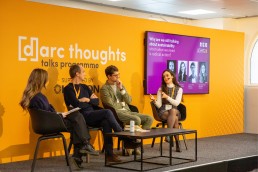
LiGHT 25 talks programme now unveiled on the LiGHT Website
(UK) – The wait is over, the talks programme for LiGHT 25 has been unveiled, with both the main stage and Associations Lounge schedules now live on the LiGHT website.
This year’s [d]arc thoughts talks programme, curated in collaboration with Lutron, has also been officially CPD-accredited for the first time. Across two days, the stage will host a line-up of international designers, industry leaders and creative thinkers, covering everything from sustainability and inclusivity to AI, multisensory design and the crossover between lighting and medicine.
Day one highlights include the Dark Skies discussion, moderated by arc’s editor Matt Waring, a session from Willie Duggan on what lighting designers can learn from medicine, and an exploration of multisensory design with the RNIB and Buro Happold. Later in the day, sessions will dive into the role of data transparency in sustainable design, the creative potential of AI in lighting practice, and a behind-the-scenes look at this year’s Re:Vision installation with renowned architectural lighting studio, Speirs Major Light Architecture.
On day two, highlights include Bentley’s presentation on crafting light as the “fourth material,” where the team will reveal how they blend artistry, technology and nature-inspired design across interior and exterior environments. Surbhi Jindal, Women in Lighting Ambassador for India, will share insights into bespoke lighting craftsmanship, exploring the fusion of traditional techniques and modern innovation to create timeless designs. Other sessions focus on the challenges of international projects with dpa lighting consultants, and a panel discussion on procurement practices that examines how even the most carefully considered designs can be compromised during delivery.
Alongside the main stage, the Associations Lounge, supported by Studio Due, will feature its own dedicated programme. Industry associations, including the ILP, LIA and IALD will take to the stage, alongside the return of the Silhouette Awards mentoring programme.
Discover the full [d]arc thoughts LiGHT 25 programme via www.lightexpo.london/talks-programme
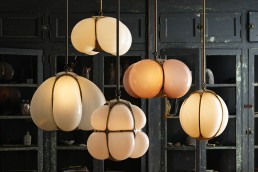
Lindsey Adelman Studio launches Overglow
(USA) - Lindsey Adelman Studio has introduced Overglow, a series of illuminated pendant lights exploring the balance between fluidity and restraint.
The collection draws inspiration from the 16th-century caged glass lampioni of Murano, once used to light pathways along Venice’s canals after dark. In Adelman’s interpretation, cushion-like mouth-blown glass appears to press against and expand through softly rounded metal frameworks, evoking moments of tension and release.
Each pendant is made to order, with glass forms paired with sandcast bronze frames available in patina brass, aged nickel and blackened bronze. The series includes four designs, each combining frame finishes with glass in subdued, jewel-like tones such as dew, opal, fog and plum. The resulting works function both as lighting and as sculptural statements.
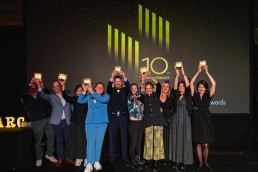
[d]arc awards 2025 open for entries
(UK) – The [d]arc awards, an international event celebrating excellence in lighting design, has opened entries for its 2025 edition.
The awards recognise projects and products across the lighting industry, with eligibility extending to lighting designers, architects, interior designers, and product designers. Once a shortlist is created by an international jury, independent designers and architects are invited to vote for their preferred projects and products. This peer-to-peer voting process is what distinguishes the [d]arc awards within the sector.
This year also marks the continuation of the “Best of the Best” category, awarded to the most highly regarded entry across all categories.
The 2024 edition included a celebratory event at Woolwich Works in London, attended by professionals from across the global lighting community.
Organisers highlight that the awards not only showcase innovation in lighting but also provide a platform for industry networking and visibility. Sponsorship opportunities remain available for organisations seeking to align with the event.
For more information on entries or sponsorship, contact Paul James at p.james@mondiale.co.uk.
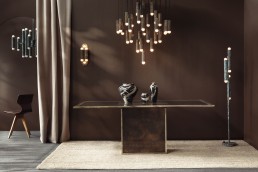
Schwung unveils Vesta Collection
(Poland) - Lighting brand Schwung launches its latest collection, Vesta, this September. The 12-piece series takes its name from the Roman goddess of the hearth and explores fire as a historic symbol of community and domestic life.
The collection spans floor, table, wall, and ceiling fixtures, with designs referencing both brutalist architecture and classical forms. Vertical brass elements echo ancient cannelures, while softer contours are said to draw inspiration from draped garments of antiquity. According to Schwung, the result is a balance between sculptural tension and contemporary refinement.
Each piece in the collection is available in three hand-applied brass finishes: Shadowed Gild, Verdigris Ash, and Rose Ash. The fixtures are also designed to adapt to varied architectural contexts, including vaulted or angled surfaces, and incorporate dimmable light to accommodate changes in atmosphere.
Dominique Sente, Co-founder and Creative Director at Schwung, says: “In the dialogue between designers and makers, we’ve spent years listening, attuned to the evolving desires of our most discerning clients. The wish was clear: a lighting collection that captures both classical depth and contemporary restraint. A sculptural language that speaks not loudly, but profoundly. Something edited, elemental, and rare. Vesta is our answer.”
darc lighting tour joins Design London Shoreditch
(UK) – The upcoming debut of Design London Shoreditch (DLS), running from 16-18 September as part of the Shoreditch Design Triangle, will include the darc lighting tour, a curated journey through some of the most innovative lighting installations and showrooms in East London.
Led by Media 10’s Design Division Director, Marlon Cera-Marle, the tour will offer visitors the chance to explore product launches, immersive installations, and expert perspectives on the future of lighting design.
The three-hour programme, beginning at 10:30 with breakfast at the Lee Broom showroom, will continue through a series of lighting-focused destinations including Tala, Buster & Punch, The Wax Building, The Light Lab, XAL, and the House of Icon exhibition at Shoreditch Town Hall.
The darc lighting tour is part of the wider DLS programme, which will take place across three venues: Design at Work (Protein Studios), Design Culture (Kachette), and House of Icon (Shoreditch Town Hall). Each will explore distinct aspects of contemporary design, from workplace innovation and cultural influence to interior design trends.
Lighting will be a central theme across the wider programme. Among the highlights are LightMass^, the new brand from Raw-Edges Design Studio, unveiling its latest integrated LED collection following last year’s award-winning debut; Tala, presenting its immersive Sunset Room installation and film in collaboration with designer Thomas Heatherwick; and Lee Broom, showcasing three new product launches for 2025 within his flagship showroom. Other contributions include 2LG Studio’s group exhibition, an AI-generated artwork by Ben Cullen Williams in collaboration with Google DeepMind, a bar installation by Lois O’Hara, and further presentations from the British Council, ISOLA, and Moleskine.
The darc lighting tour forms a key part of this inaugural edition, offering visitors a dedicated opportunity to explore the role of light in design while engaging directly with industry leaders and innovators. Registration is available via the Design London Shoreditch website:
www.designlondonshoreditch.com/darc-lighting-tour
Why mentoring matters
https://vimeo.com/1114185073
Women in industry Networking Brunch, hosted by darc magazine, brings together leading voices from Women in Lighting, Women Lighting Professionals, Women in Office Design, Women in Architecture, and the Women in Furniture Network. This engaging event offered a unique opportunity for women across design and architecture to connect, share experiences, and discuss the challenges and opportunities in their respective fields. Expect insightful conversations, industry insights, and collaborative discussions on topics such as career growth, diversity in design, leadership, and the future of women in the built environment.
Technical Zone to debut at LiGHT 25
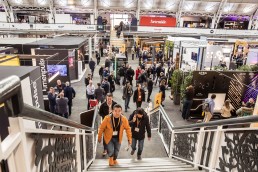
(UK) - LiGHT 25, the UK’s only trade show dedicated to high-end lighting specification, is set to return to the Business Design Centre in Islington, London, on 19–20 November 2025. Building on the success of last year’s event, which drew more than 5,500 visitors, the 2025 edition will feature a host of new innovations, with the launch of a dedicated Technical Zone as a major highlight.
The new zone, will be a dedicated space for brands focused on shaping the future of urban lighting, commercial lighting, control systems, components and OEM, lamps and gear, and emergency lighting. As lighting controls, emergency systems, and advanced components continue to play an increasingly important role in sustainable and human-centric design, the Technical Zone will offer an invaluable platform for both exhibitors and visitors to connect with industry experts, explore the latest products, and gain insights into technical advancements.
LiGHT 25 continues to attract thousands of architects, interior designers, lighting designers, engineers, and specifiers, all eager to see the latest product innovations and launches from hundreds of architectural and decorative lighting brands. Organised by [d]arc media, the event offers a rich programme of activities beyond the exhibition floor.
The renowned [d]arc thoughts talks programme will once again take centre stage, bringing together leading voices from the industry to discuss the latest trends, technologies, and challenges in lighting design. Moderated by editors from the industry’s leading magazines arc and darc, alongside guest moderators, the talks provide valuable insights into the future of lighting. The dedicated Associations Lounge will also return for a second year, offering an exclusive platform for professional organisations and featuring a dedicated splinter talks programme.
LiGHT 25 is more than just an exhibition – it’s a hub for industry connections. Visitors can network at the late-night drinks party on the 19th November, engage in insightful conversations at the networking brunch, or collaborate in the dedicated co-working space.
Lighting the way from concept to creation, LiGHT 25 continues to set the benchmark for the industry, and it is completely free to attend. Don’t miss the opportunity to experience the latest in lighting innovation and expand your professional network.
For more information, visit: www.lightexpo.com
Design London Shoreditch to launch during LDF
(UK) – A new design event is set to join Shoreditch Design Triangle this September, as Design London Shoreditch makes its debut on the 16th-18th.
The three-day showcase will feature a programme of exhibitions, installations, talks, and workshops, spread across three East London venues: Design at Work at Protein Studios, Design Culture at Kachette, and House of Icon at Shoreditch Town Hall.
Each venue will explore a different strand of contemporary design. Design at Work, curated by OnOffice, will focus on workplace innovation, highlighting products that aim to improve wellbeing and productivity. Design Culture will examine the role of cultural influence in design, with contributions from independent designers, artists, and Kingston University graduates. House of Icon will transform Shoreditch Town Hall into an interiors showcase, presenting a range of styles from Scandinavian minimalism to bold maximalism.
Lighting will feature prominently across the programme. LightMass^, the new brand from Raw-Edges Design Studio, will present its sustainable approach to sculptural minimalism. Following its debut at London Design Festival 2024, with accolades including a British Design Guild Mark and EDIDA 2025 for Best Lighting, the brand will unveil a new integrated LED collection at this year’s edition.
The talks programme, co-curated by design journalist Roddy Clarke, will add further discussion and debate to the programme, with sessions exploring contemporary issues in design.
Ben Evans, CBE, Director of London Design Festival, says: “The launch of London Design Shoreditch is a bold and exciting new addition to the festival programme, and one that reflects Shoreditch’s position as a vibrant creative hub. I look forward to seeing Design London Shoreditch become a vital platform for both emerging talent and established voices in our community.”
www.designlondonshoreditch.com/register
[d]arc dialogues… Adam Britnell (DLSM Studio) on Noreen
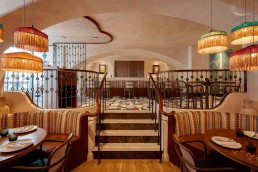
 DLSM Studio - the multidisciplinary interior design and branding agency formerly known as Design LSM - proudly unveils Noreen, a bold and evocative new restaurant at the heart of St Christopher’s Place, London. Housed within a 2,900 sq ft Grade II listed former retail space, Noreen is a vibrant celebration of cultural richness and contemporary dining. The design draws inspiration from the name itself, “Noreen” meaning “two lights” in Arabic, exploring duality through both source and effect. This narrative of light is expressed throughout the design, creating an immersive dining experience that feels at once intimate and dramatic. We spoke with Adam Britnell, one of the creative leads behind the project, to uncover the story of the lighting design and its central role in shaping the restaurant’s distinctive identity.
- “Noreen” literally means “two lights” in Arabic — how did this concept of duality influence your approach to the lighting design?
Inspired by the name, the space was designed to explore light from a dual perspective of source and effect, evoking the romance and cultural vibrancy of Arabia, through shadows, forms, colours and textures.
- The interplay of shadow and texture is very apparent throughout the space — how did you use lighting to enhance the tactile qualities of materials like stucco plaster, woven palm, and stained glass?
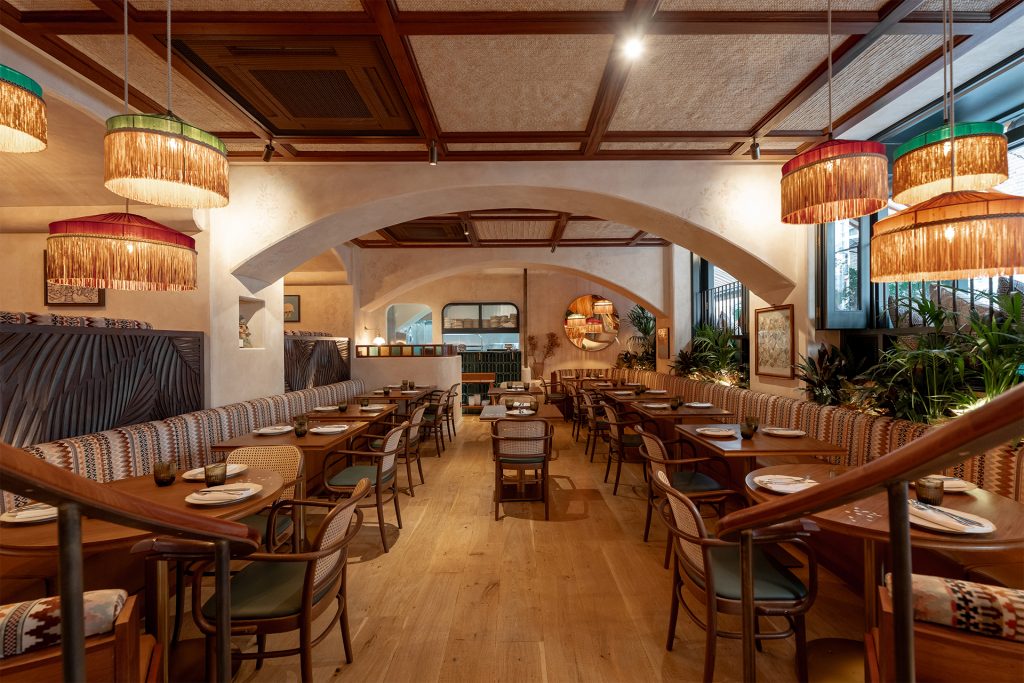
Natural lighting was a key consideration for us, we were keen to utilise natural light as much as possible and where available, enhancing guest's experience wherever they are positioned. We designed window booth seats that not only provided a pleasant eating experience but also helped bring the outside into the interior space. For spaces where the natural light couldn’t reach, or into the evenings, we utilised subtle lighting techniques, such as well-placed spike lights in the planters to help spread the shadow of the plants, or small spotlights set behind the lower seat to wash against the palm motif on the booths. The client was also keen not use too many LED washes, and so we used plastered-in ceiling spots which were mainly directed against the stucco walls, rather than directly to the floor or tables.
- Given the Arabian inspiration behind the space, were there traditional motifs or regional lighting techniques you reinterpreted in a contemporary way?
You may notice subtle, washed-out motifs painted directly on the plaster, which not only add a layer of narrative through their styling but also resemble the effect of palm shadows cast against walls in the low Arabian sun. We also used coloured stained glass discs within the screens and balustrade, which radiate colour when lit, resembling decorative jewellery or the building technique often used in the Middle East of installing glass bottles into walls.
4. The restaurant features several spatial experiences - from intimate alcoves to an open kitchen and indoor/outdoor seating - how did the lighting strategy shift across these zones, as well as how did you maintain cohesion in these areas?
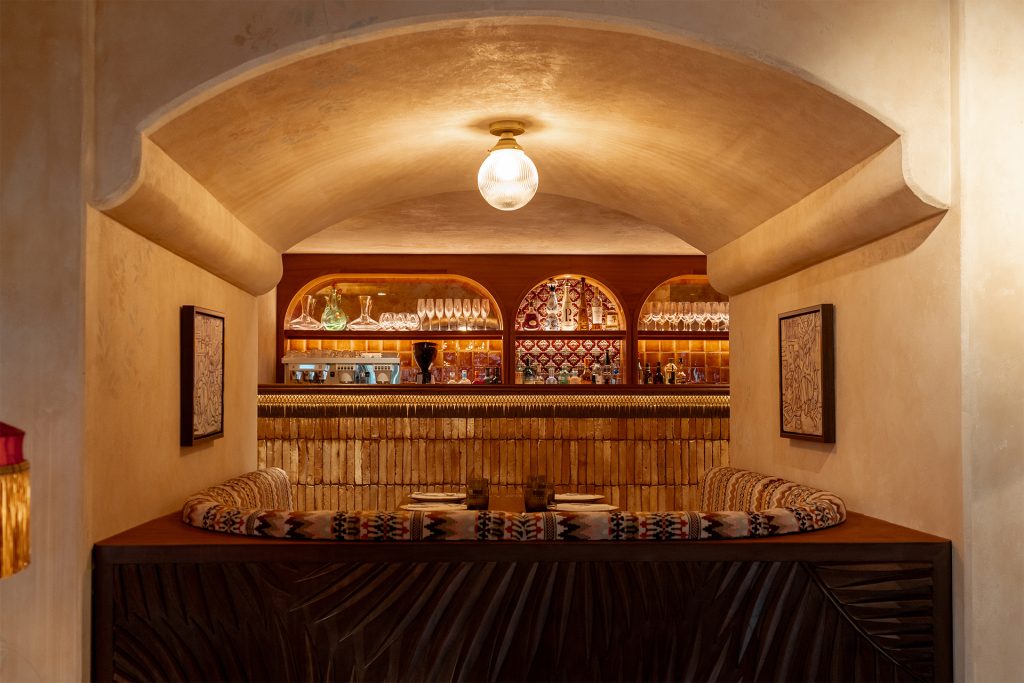
We wanted the space to reflect the cool sensation that interiors give when you’re in hot climates (despite being in cool and wet London), but for it still to be dynamic and energetic. The lower main ‘pit’ is closest to the natural light and so organically has more energy about the space, we used bold coloured decorative fringed pendants over the seating to keep the energy higher. For the intimate alcove booth seating, we didn’t want to over-light it, and so by keeping them open on both sides, and having such a low ceiling, a small decorative cut glass overhead light was more than enough to create the required, cosy, relaxed ambience.
- Noreen lives within a Grade II listed building. Were there any constraints or challenges in integrating the lighting infrastructure into the heritage fabric of the space?
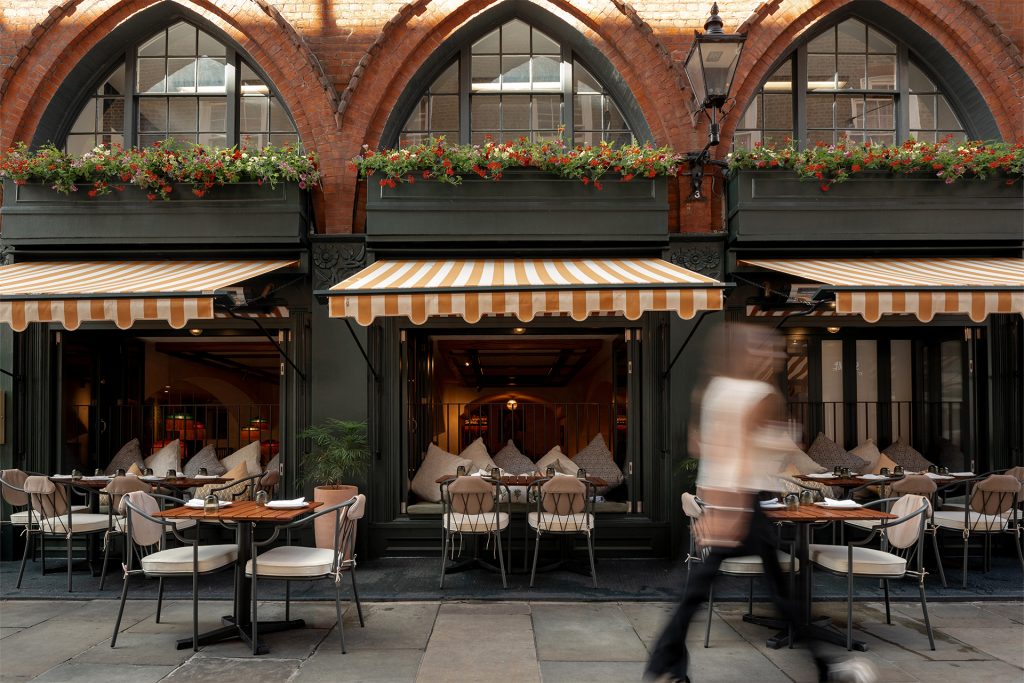
External lighting was generally our biggest issue when it came to sympathetic lighting. However, by lining the façade with window booths, we could utilise the spill of light from inside to create a warm and inviting ambience, especially via the planting spike lights which were behind these booths. We had to keep the demise of the external seating close to the façade, and so we used subtle, antique brass spots, and a warm yellow awning to hold the light close to the guest.
- Did the open kitchen and dessert bar present any specific lighting challenges or opportunities, especially in creating both drama and clarity for staff and guests alike?
Naturally, an open kitchen can cause issues when it comes to light bleed. However, due to the nature of this being a finishing kitchen, we were able to use warmer notes of light, which were hidden from the main restaurant via bulkheads, to give adequate lighting for the chefs, without ruining the ambience for the guests.
- Was there a conscious decision to “stage” specific areas with theatrical lighting, or did you opt for a more subtle approach?
Our client was keen not to over exaggerate the lighting, especially if that meant seeing exposed LED sources, so we therefore designed towards a more subtle approach. When you look at the dishes that Noreen serves, you can see the vibrancy and passion that they are putting into their food, which is so typical of beautiful Arabian meal times; therefore, we didn’t want to detract with dramatic lighting techniques and instead focused on the food being the ‘star of the show’.
- How closely did the lighting design tie in with the branding and narrative of Noreen?
We also designed the branding identity for Noreen, and so we built the narrative and tone of voice from the ground up This idea of the cause and effect of lighting was considered from the outset.
- Finally, how do you want guests to feel when they experience Noreen?
We wanted the design to evoke that feeling of when you escape the hot, late afternoon sun. A sense of relief and calm, but not to an extent that you lose the vibrancy and fun that Noreen as a brand wants to portray. The light had to be warm, with dashes of colour, and in some cases, such as the nooks, sparse. The lighting strategy was well considered, with a strong focus around the effect it creates after - the shadow from the plants, the colour from the glass, the reflection against a mirror or the texture of the plastered walls.
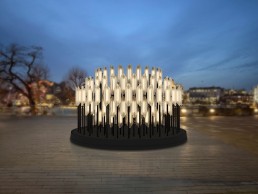
Lee Broom to create sculptural lighting installation for LDF
(UK) – For the 23rd edition of London Design Festival (LDF), product designer Lee Broom will present a sculptural light installation in collaboration with Czech manufacturer Brokis and bespoke manufacturer Materials Assemble.
Titled Beacon, the work takes inspiration from its riverside location, using the surrounding architecture and legacy as a prompt. Made using a glass-fusing technology developed to upcycle discarded glass fragments, the installation reinterprets classic street lamps to form a structure collectively resembling a vast sculptural chandelier.
Running from 13-21 September, Broom’s sculpture will be one of many installations and exhibitions taking place across the capital, with a focus this year on design’s role in addressing contemporary global challenges.
Following the festival, components of the piece will be repurposed into individual light fixtures, extending its use and supporting sustainable design practices.